This blog was started to record the journey of starting a new kind of church for the NYC artistic community (which includes anyone who loves the arts - many non-artists), and to be a place for discussion of Art & Faith issues.
Well, we have reached a major milestone - our first full Sunday worship gathering.
Just to let you know, we didn't choose Sunday morning for traditional reasons - we were desiring to find the best time, whether on Saturday, Sunday or Friday, to have a weekend gathering with a full worship liturgy. It turns out after talking to a lot of people and doing a poll, for our demographic - people in the NYC artistic community, that Sunday morning is the one time that everyone is available. Many have shows on Sat. night, rehearsals on Sat. afternoon, and either shows or dates on Friday night.
So for me, this has been a two and a half year journey, for the team a nine month or so journey, and there is a great sense of joy, excitement and relief.
We were humming along on Thursdays, slowly adding elements and refining others, and in December we had abandoned our previous plan to start Sundays on a pre-set date, and go instead in a more organic way - when we were ready and the Lord led us, we would go to Sundays.
So, it was only 3-4 weeks ago that it all lined up and we prayerfully decided to move to Sundays. It has been a whirlwind to do it so quickly, but that suited us well.
We had a weekend retreat the weekend before to pray and plan, and there we came up with a final amazing actual layout of the gathering. Then the whole week leading up we had a number of meetings and work times to prepare - I was exhausted by Saturday night, but amazingly peaceful and rested on the Easter morning of the gathering.
Everything went so well, and we were all amazed at how all these disparate parts came together, and how our giftings melded so well, and out of all that came this beautiful space and worshipful gathering. I've written a description of the gathering below.
One thing I want to highlight in this blog for others church planting or considering it. Prayer has been the key for us, our modus operandi. We never talk and discuss ideas and plans without having prayed first. We want to be in that post-prayer, spirit led, state of mind when we discuss and make decisions about something as important as the body of Christ and how it gathers to worship.
We truly believe that Jesus leads the church, and so we would never presume to think we know what to do without hearing from Him first. After we pray, we trust that he will lead us and we get crazy creative.
It has been so thrilling for me to watch my dream come true - to have artists create an entirely original worship liturgy. The team that God has gathered to do this have just an amazing set of gifts to envision and execute wildly creative original ideas.
So now we look forward to growing and developing as a body of Christ - to love one another as God has loved us, and to draw people to God's love.
Here's a description of our inaugural Sunday worship gathering:
*************
As for our first Sunday gathering, wow, what an amazing day it was. We transformed this room we have here in the Lamb's theater - ceiling drapes billowing out in all directions. Japanese rice paper lamps, many candles.
In the beginning, we had everyone outside, and the team stood in a circle around the chairs, which were in an oval circle, and we hummed a tune of greeting while the people came in and each received a flower, and then joined with our simple hum to continue greeting the rest coming in, all accompanied by jembe drum and guitar.
After everyone was in and we had transformed the humming to singing words to the same melody, and after a brief welcome and opening prayer, we had the jembe play while an original poem written for the service was proclaimed. When the poem was halfway through an amazing young dancer came out and danced sometimes following and sometimes leading the jembe, this culminated in an exciting flourish of sound and movement that really must have thrilled the heart of our Lord.
Then we took our first small steps towards congregational harmony and taught everyone some simple harmonies that undergirded a solo sung melody, and this will be developed with increasing complexity over time.
Then one of the members of our congregation that has been blossoming before everyone's eyes over recent months, shared her testimony of dramatic and brutal sexual and ritual abuse as a child, and then presented to us a beautiful sculpture of a tree with leaves made out of little origami's that represented her journey from horror to the Lord's sweet and ongoing redemption of her heart and mind. It will be a permanent part of our worship space.
As we were all deeply moved by her story, and the beauty of the sculpture, we followed that by a moment of silent prayer and reflection. And out of that silence came the piercingly beautiful soprano voice of an opera singer, joined soon by a tenor singing a gorgeous duet in Hebrew.
Then some more worship singing by the congregation (with congregational harmony) and a short talk on our hopes for Communion of the Arts which flowed naturally into remembering our Lord with the sacrament of communion. For this we had three stations set up, and we gathered around them like a family meal and all greeted one another. After reading the scripture, we each in our time took some of the bread dipped it in the wine and ate.
Then another song in harmony, and for the scripture text, an actor dramatically spoke the text from memory.
Then I came to give a brief overview of the scripture text, before going to our small groups to spend time getting to know one another, and teach one another the scripture.
At the end we all came back for the artShare - a chance to experience the art of someone we know whether Christian or not, and some announcements and closing prayer.
Thank you all for your prayers, it was a wonderful time and we are looking forward to it's ongoing development and to growing closer as a community.
Wednesday, April 19, 2006


Friday, April 14, 2006
Wall Street Journal encourages us!
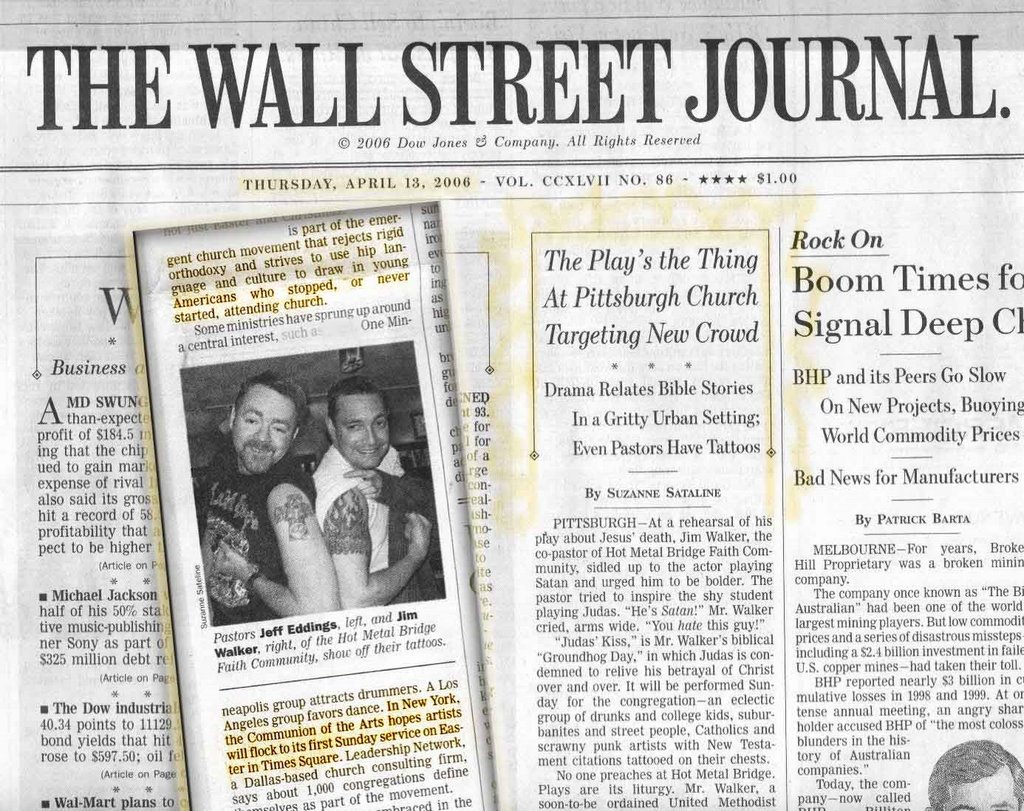
Thanks for the encouragement Lord! (and to the reporter from the WSJ!)
Details of our first Sunday gathering on Easter in the post below.
(click on the picture to make it bigger)
It's an article on a church in Pittsburgh that uses drama as their liturgy, so the reporter wanted to talk to others doing a similar thing. If you can't read it, it says "In New York, the Communion of the Arts hopes artists will flock to its first Sunday service on Easter in Times Square". That's it, but it was on the front page!
She didn't quote any of the other great things I said during our interview - but that's probably for the better knowing how they will skip over the 95% of good things you said and quote the one stupid thing (although with me that might be more like 75%/25%).
Monday, April 10, 2006
Easter Sunday!
Many other cultures call it Resurrection Sunday, and it is definitely a time of new beginnings - like all of mankind being redeemed - each of us being given a new start.
For us this is the time where we go from being a home group plus, to becoming a full fledged church on Sunday mornings.
For me it is quite amazing to see this thing after 2 1/2 years fully blossom. The more amazing thing to me is to see how it is the blossoming of so many people that are the actual petals of the larger blossom.
It's like one of those pictures, that when you get closer you see it is made up of so many smaller snapshots of people and the computer has arranged it according to the various hues and the light and dark parts, so that when you pull back it is a big beautiful picture.
We are going to have dance and sculpture and dramatic readings and baptism and communion and a beautiful space and a chance to teach one another the scripture.
Our dream has always been that we will draw artists and those that love the arts in and bring them together to create an entirely original and beautiful public worship liturgy - and that is exactly what is happening.
I was just interviewed this morning by the Wall Street Journal for an article they are doing on a church in Pittsburgh that is using drama in their worship service - so that is a great thing for the future of this movement towards the arts within the church, and maybe if we are mentioned in the article we will be heard about by some who may have been desiring a fresh new way of being with God.
Please come, you are welcome.
Here's the details:
Easter Sunday, April 16th
11am
The Lamb's Theatre
130 W. 44th St. (between 6th & 7th Aves.)
New York City
Right in Times Square
For us this is the time where we go from being a home group plus, to becoming a full fledged church on Sunday mornings.
For me it is quite amazing to see this thing after 2 1/2 years fully blossom. The more amazing thing to me is to see how it is the blossoming of so many people that are the actual petals of the larger blossom.
It's like one of those pictures, that when you get closer you see it is made up of so many smaller snapshots of people and the computer has arranged it according to the various hues and the light and dark parts, so that when you pull back it is a big beautiful picture.
We are going to have dance and sculpture and dramatic readings and baptism and communion and a beautiful space and a chance to teach one another the scripture.
Our dream has always been that we will draw artists and those that love the arts in and bring them together to create an entirely original and beautiful public worship liturgy - and that is exactly what is happening.
I was just interviewed this morning by the Wall Street Journal for an article they are doing on a church in Pittsburgh that is using drama in their worship service - so that is a great thing for the future of this movement towards the arts within the church, and maybe if we are mentioned in the article we will be heard about by some who may have been desiring a fresh new way of being with God.
Please come, you are welcome.
Here's the details:
Easter Sunday, April 16th
11am
The Lamb's Theatre
130 W. 44th St. (between 6th & 7th Aves.)
New York City
Right in Times Square
Wednesday, March 29, 2006
Paul Bunyan, Modern-Day... [attractability]... Symbol
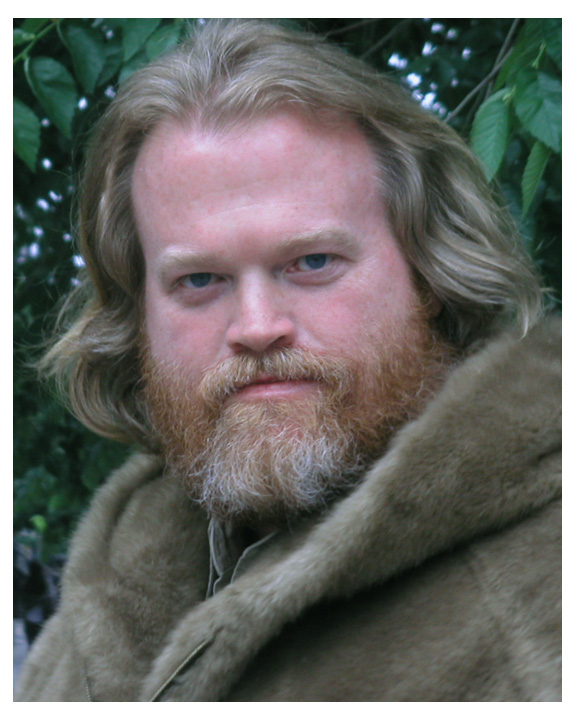 "It's a sign of the times," Mr. Martin said. "People are into beards right now."
- NY Times
My hair is shorter than this now, but the NY Times has finally given me the acclaim I deserve as bearded trendsetter. Finally the world understands.
Paul Bunyan, Modern-Day... [attractability]... Symbol
Excerpts from the article:...At hipster hangouts and within fashion circles, the bearded revolution that began with raffishly trimmed whiskers a year or more ago (...right when I grew mine...) has evolved into full-fledged Benjamin Harrisons. At New York Fashion Week last month at least a half-dozen designers turned up with furry faces.
...Men both straight and gay, it appears, want to feel rough and manly.
(...a good description of my aesthetic...)
...And with their fully furry chins ...the editor in chief and the style director of Cargo magazine, the metrosexual manifesto, seem now to be endorsing a lumberjack ideal
(...what I've always preached...)
...'Where did you get that beard? Is that beard from Dolce & Gabbana?' "
(...of course mine's Versace...)
... "I met my current girlfriend a week after I started growing my beard...
(...obviously a misquote as a full beard takes a bit longer to acheive it's full attractability...)
..."It's like a security blanket on my face,"...
(...not that I don't have enough confidence on my own...)
..."I'm kind of into guys with beards today"...said Lola..."the pretty-boy look can only last for so long."
(...thank you for finding a woman named Lola to quote...)
the link to the article (yes, it's actually true)
If this is your first visit, it get's a lot more spiritual below.
Monday, March 20, 2006
Dismissed
When you are dismissed, you go away
Two mobsters:
“Hey, things with Joey ‘aint workin’ out”
“Whattya wanna do?”
“Joey should go away”
Interesting, the meaning of “go away” means murder, and in scripture the idea of hating someone is the same as murdering them.
In each case we simply wish the person did not exist anymore.
We do this all the time in our lives in the most casual way without realizing it – we dismiss people from our life, from our presence because we do not like them.
We want community.
But in the midst of our gatherings we constantly commit murder – we dismiss and send away. You cannot build community with multiple murders in your midst.
Just look at the words
To negate
set aside
void
abolish
dismiss
Ughhhh, such ugly words, they make me sad inside.
To love is to do the opposite, and to love well means to be vigilant to your own heart to see when you have so casually not loved.
Did you judge someone by their appearance and dismiss them?
Did you say no to the possibility of someone being promoted or accepted into a position and then after that, felt awkward around them and so avoided them?
Did you judge someone by their “inappropriateness” in a social situation, and decide you only allow yourself to be in the presence of those with advanced levels of social intelligence?
The life of faith, the life of love, is one in which we are vigilant over our behavior in these kind of scenario's to see and notice when we are dismissing others. Then to examine our hearts to see why we did it, and then to repent and ask God for the power to change, and then to work hard with his grace to permanently change such behavior. To associate with the lowly means those that you judge as below you.
That is the personal level, then there's the organizational level where power amplifies the effects. The use of power to dismiss within organizations is doubly evil because it allows you to make your dismissal more than private, but public. It causes it to be followed by others who follow you as their leader.
The way I have most often seen this take place in church or parachurch organizations, is when someone has been considered for a leadership position and then for whatever reason rejected, and often the “rejecters” feel kind of bad and so they tend to ignore the person after that. That persons presence makes them feel guilty or something, or maybe they just didn’t like the person to begin with, and so that person is not as welcomed and supported as others might be.
Often the negative effects of dismissing someone are not so much things you do against them, but rather things that you don’t do for them that you would have otherwise.
Whenever someone approaches any organization of any kind, church or secular, they need relationships within that organization that will open doors for them and usher them forward. The problem that the dismissed person has is that now doors that would have been opened for them had they been accepted, are not opened.
Once you “set them aside” they can be effectively shut down for life within that organization. That is power.
When you have the power to open doors for someone, or to close the door on them and set them aside, it is the way of Christ that you use that power very carefully and with the fear of God.
Do you know the person? Do you love them?
Are you really sure they couldn’t be accepted and helped along?
Is there something else you can steer them toward so they will be accepted rather than rejected?
If you reject them, make sure you follow that with an unusually high level of love and acceptance, and set them up to be accepted by others, and find a way to build into their life until they are ready to be accepted for that or another position.
Our church policy:
#1: Never make a decision about someone’s life who you do not know and love.
#2: We say yes. If you are a leader that has to make decisions about accepting people into new leadership positions, you almost always say yes. In the super rare case have to say no to accepting someone into a leadership position, you are automatically given the responsibility to mentor them until they can be accepted. Saying no actually requires more work, so we are more likely to say yes.
Now let’s look at the lovely words:
to accept
approve
validate
support
affirm
welcome
You can love poorly or you can love well.
Saturday, March 11, 2006
Enjoying the disadvantage of not Politicking
Politics – it starts as children when we tell Mommy things that we knowingly exclude from Daddy, so that we can get our way.
Politicking within a group is the covert building of support towards something you want in order to gain advantage over opponents, so that they don’t have time to build equal support. You politic so that you can win, whether by vote or organic popular approval or by influencing a decision maker. When you do this, it is essentially not loving to those you oppose because it does not put their highest as your goal. It places you above others, and above the entire community, and is therefore what I call all things that are destructive to healthy community – sin.
The Broadside – Even a dirty mobster like Tony Soprano, understands the concept of politicking, and the need to mitigate it within groups because of its harmfulness. In a recent episode of the Soprano’s, he had a secret meeting with someone, and after it concluded successfully, he informed them that his next call would be to a particular person who was affected, so that they would not find out at the last minute and be broadsided [update: actually he said blindsided, but I like broadsided better of the two synonyms].
Building a personal agenda-driven political coalition within a group creates exclusion and rejection of those you don’t include. Not telling someone the full truth about an issue you are pursuing, but going behind their back covertly and building a political coalition of those with the same view as yours is deeply destructive to the group because right at its core, at its very heart you have rampant self absorption driving a wedge through the group for the benefit of the wedge drivers against the trumped, the surprised, the ambushed, the broadsided, the rejected.
Christ has shown us a better way. The first of his ways is that he always puts the highest of the other as his greatest goal. The second is how this connects to unity – the putting of the overall group’s union and wholeness and integrity over the individual desires of members.
When an individual member of a group feels a desire to see change within the group for some reason that might benefit him or others, they should pray and ask Jesus if this is a good thing to pursue – it very well may be. In fact one of the reasons it is easy to not notice the temptation of politicking pulling you in, is that it often happens in the pursuit of a very good thing. But when a good thing at a smaller level creates disunity at a bigger level, it becomes a bad thing.
The goal is to get the good small thing, while maintaining the good big thing.
First, pray (and let me say that when I say pray, I mean a very kind of thoughtful spiritual formation prayer that is the whole person thinking, reading scripture and other good books, talking to others and praying specifically to God – the whole person with all faculties reaching outside of itself and asking God to speak through these multiple formats). By first asking Jesus if this is a good thing to pursue, this will automatically erase many of the problems because so often the Holy Spirit is very clear to show you that you are pursuing something for the wrong reasons, and you choose to obediently give it up.
But when the Lord encourages you that this could be a good thing for the group, then your next step is to pray and ask for wisdom on timing – when do you begin to propose this idea to others? Maybe there are obvious issues that could be overcome just by waiting for a period of time.
Then after sensing that it is right, and the timing is good, then pray and think about how to begin sharing it with others. Here is the moment when most temptations to politic arise. Our selfish desire to get our way, combined with our basic social intelligence easily sees the lines as they lay out – we see who would be the best to talk to and who would be the worst to talk to.
The key is to put the good of others first, and the good of the entire group first.
If this is an issue that doesn’t so much affect the whole group as it does a particular individual in the group, then they are the first person you should talk to. This is the essence of the broadside – you talk to others, and then after raising support, you talk to them, and hit them with not only your personality but with the extra bulk of others adding weight and velocity to your purpose. They are hit right on the side and shocked by the force of the blow.
The broadside is not loving. (Nor the Soprano blindside)
Love them by going to them first while it is still just a little thought in your one head, that you individually share with them, and that you let them know it is just a little thought in your head and carries no more weight than that. They will be able to hear the idea as a personal word from you that carries your heart and gives it to them. Normal human relationship can ensue.
What if they don’t agree and reject your idea?
Then you have to once again resist the temptation to politic and give it some time to settle in. Maybe it will percolate in their mind a bit, and they will change their mind, or come to you with a modified version that works even better. Also God can speak to them and change their mind. Much of loving others well has to do with trusting God to lead others, and not exerting your own energy to influence selfishly or manipulate.
If the idea you have affects the entire group, rather than just individuals within it, and the group has a leadership structure, then you should definitely go to the person within the group that has been tasked with the responsibility to receive such ideas from members of the group. It may not be the head leader; there may be some chain of command, where ideas flow up through the levels of the leadership structure.
Or if it is a more organic group with no clear leader, then simply mention it to everyone at once at the same time in a meeting, where they are all hearing it simultaneously. If there are no meetings, than just begin to tell it to others or small groups of others until you’ve told everyone with a firm watch on your own hearts desire to politic.
It may be that rather than affecting an individual, it affects a certain wing of the group – go to them first. Or you may know an individual who you know won’t support it, even though it doesn’t affect them, so you go to them first so that you are forcing yourself to avoid politicking.
This becomes much more complex when you apply it to business and governmental organizations, where politics may be a good and planned part of the culture, but even there you have to separate between where politics is good and where it is bad – for example, it may be good for Senators to politick amongst themselves concerning bills awaiting vote, but it may not be good for staff members of a single Senator to politic within their office.
The risk of avoiding politicking is that others may not be so loving, and will immediately commence politicking themselves. You will have “shown your hand” too soon, and put yourself at a disadvantage – but that disadvantage that you now enjoy, is the fellowship of deep communion with the one who put himself at the ultimate disadvantage.
The healing of the world is only possible when many put themselves at the disadvantage of loving others above themselves. You may endure many small sufferings when you choose to pick up your cross and die for others, but you will win in the end when Jesus returns and finds you standing at your post doing his work and living out his radical “others focus” on earth.
Politicking within a group is the covert building of support towards something you want in order to gain advantage over opponents, so that they don’t have time to build equal support. You politic so that you can win, whether by vote or organic popular approval or by influencing a decision maker. When you do this, it is essentially not loving to those you oppose because it does not put their highest as your goal. It places you above others, and above the entire community, and is therefore what I call all things that are destructive to healthy community – sin.
The Broadside – Even a dirty mobster like Tony Soprano, understands the concept of politicking, and the need to mitigate it within groups because of its harmfulness. In a recent episode of the Soprano’s, he had a secret meeting with someone, and after it concluded successfully, he informed them that his next call would be to a particular person who was affected, so that they would not find out at the last minute and be broadsided [update: actually he said blindsided, but I like broadsided better of the two synonyms].
Building a personal agenda-driven political coalition within a group creates exclusion and rejection of those you don’t include. Not telling someone the full truth about an issue you are pursuing, but going behind their back covertly and building a political coalition of those with the same view as yours is deeply destructive to the group because right at its core, at its very heart you have rampant self absorption driving a wedge through the group for the benefit of the wedge drivers against the trumped, the surprised, the ambushed, the broadsided, the rejected.
Christ has shown us a better way. The first of his ways is that he always puts the highest of the other as his greatest goal. The second is how this connects to unity – the putting of the overall group’s union and wholeness and integrity over the individual desires of members.
When an individual member of a group feels a desire to see change within the group for some reason that might benefit him or others, they should pray and ask Jesus if this is a good thing to pursue – it very well may be. In fact one of the reasons it is easy to not notice the temptation of politicking pulling you in, is that it often happens in the pursuit of a very good thing. But when a good thing at a smaller level creates disunity at a bigger level, it becomes a bad thing.
The goal is to get the good small thing, while maintaining the good big thing.
First, pray (and let me say that when I say pray, I mean a very kind of thoughtful spiritual formation prayer that is the whole person thinking, reading scripture and other good books, talking to others and praying specifically to God – the whole person with all faculties reaching outside of itself and asking God to speak through these multiple formats). By first asking Jesus if this is a good thing to pursue, this will automatically erase many of the problems because so often the Holy Spirit is very clear to show you that you are pursuing something for the wrong reasons, and you choose to obediently give it up.
But when the Lord encourages you that this could be a good thing for the group, then your next step is to pray and ask for wisdom on timing – when do you begin to propose this idea to others? Maybe there are obvious issues that could be overcome just by waiting for a period of time.
Then after sensing that it is right, and the timing is good, then pray and think about how to begin sharing it with others. Here is the moment when most temptations to politic arise. Our selfish desire to get our way, combined with our basic social intelligence easily sees the lines as they lay out – we see who would be the best to talk to and who would be the worst to talk to.
The key is to put the good of others first, and the good of the entire group first.
If this is an issue that doesn’t so much affect the whole group as it does a particular individual in the group, then they are the first person you should talk to. This is the essence of the broadside – you talk to others, and then after raising support, you talk to them, and hit them with not only your personality but with the extra bulk of others adding weight and velocity to your purpose. They are hit right on the side and shocked by the force of the blow.
The broadside is not loving. (Nor the Soprano blindside)
Love them by going to them first while it is still just a little thought in your one head, that you individually share with them, and that you let them know it is just a little thought in your head and carries no more weight than that. They will be able to hear the idea as a personal word from you that carries your heart and gives it to them. Normal human relationship can ensue.
What if they don’t agree and reject your idea?
Then you have to once again resist the temptation to politic and give it some time to settle in. Maybe it will percolate in their mind a bit, and they will change their mind, or come to you with a modified version that works even better. Also God can speak to them and change their mind. Much of loving others well has to do with trusting God to lead others, and not exerting your own energy to influence selfishly or manipulate.
If the idea you have affects the entire group, rather than just individuals within it, and the group has a leadership structure, then you should definitely go to the person within the group that has been tasked with the responsibility to receive such ideas from members of the group. It may not be the head leader; there may be some chain of command, where ideas flow up through the levels of the leadership structure.
Or if it is a more organic group with no clear leader, then simply mention it to everyone at once at the same time in a meeting, where they are all hearing it simultaneously. If there are no meetings, than just begin to tell it to others or small groups of others until you’ve told everyone with a firm watch on your own hearts desire to politic.
It may be that rather than affecting an individual, it affects a certain wing of the group – go to them first. Or you may know an individual who you know won’t support it, even though it doesn’t affect them, so you go to them first so that you are forcing yourself to avoid politicking.
This becomes much more complex when you apply it to business and governmental organizations, where politics may be a good and planned part of the culture, but even there you have to separate between where politics is good and where it is bad – for example, it may be good for Senators to politick amongst themselves concerning bills awaiting vote, but it may not be good for staff members of a single Senator to politic within their office.
The risk of avoiding politicking is that others may not be so loving, and will immediately commence politicking themselves. You will have “shown your hand” too soon, and put yourself at a disadvantage – but that disadvantage that you now enjoy, is the fellowship of deep communion with the one who put himself at the ultimate disadvantage.
The healing of the world is only possible when many put themselves at the disadvantage of loving others above themselves. You may endure many small sufferings when you choose to pick up your cross and die for others, but you will win in the end when Jesus returns and finds you standing at your post doing his work and living out his radical “others focus” on earth.
Monday, February 27, 2006
More on My Gay Position
The original post below is getting a little long, so I will continue it here. Please read the original post below in order to get the main idea I've presented.
I am so excited by all the comments which allow me to continue refining and developing my understanding.
A fundamental concept of my approach is that change is needed. There are a lot of well meaning Christians that in their heart would love to see all humans know the love of Jesus, but are unfortunately ignorant of how deeply entrenched cultural norms have left certain people excluded.
If you are under, say, 50 years old, you can still have the interesting experience of hanging out with your older relatives, and hearing them say things that are so blatantly racist as to be almost humorous in how it points out the depth of their ignorance of how far we have come as a people called Americans. You still love them, but you don't accept their view of the world.
Think of your life as a devout Christian, and all the personal struggles you have to live out your faith, to avoid temptations to sin, and to find the time to pray and actually walk in faith alongside God. Now just imagine a hundred years ago, some Christian going through all those same struggles, similarly hoping to be faithful to Jesus who they know has saved them, and who they desire to serve with their whole heart as they read their bible and try to find the time to pray, etc. And that Christian one hundred years ago, happens to own amongst their possessions, some humans that were recently exported from Africa.
They had just as real a faith as you have. Yet they owned Colin Powell's great, great, great grandfather. They hoped that their children would be good and get good grades and that their community would be warm and peaceful, and yet they owned Miles Davis great, great grandmother. They owned humans. They inspected their teeth like cattle in order to be good stewards of the money God had given them so they could invest wisely in a healthy slave - as you spend hours making sure you're buying the best washing machine.
Rosa Parks was 42 when she refused to give up her seat, and the Mother of the Civil Rights Movement only just recently passed. I am only 42 years old myself, and I was born in 1963 before most of the big events of the Civil Rights movement happened. We are just now barely emerging from our institutionally racist past, and have a long way to go to be free from our still culturally racist present.
With all that in mind, knowing that fellow Christians we will be with in heaven one day only recently owned humans, it must force us to our knees to say, "Lord! What areas of our culture are we abominably ignorant of our own superiority??"
"Where do we fail to see that a fellow Christian has been treated as less than a fellow Christian?"
Or a fellow human as less than a fellow human.
It's amazing to me that the people who were treated as less than human by their Christian owners, themselves became Christian - and whose Christian faith has been one of the most remarkable cultural phenomenon's of our Country's history!!!!????!!!!
What if homosexual Christian's one day are the most vibrant and amazing Christian's in America, and you look back and remember when you thought they couldn't even be Christians??? (or at least your actions and words represented that, although you wouldn't say that).
We must be vigilant to see who we are. There were a bunch of vigilant slave owning Christians a hundred years ago, and they became the abolitionists that lead to change.
Here is a good observation of how we don't understand ourselves, and how our views really manifest themselves:
When Brian McLaren was on the Larry King show with a bunch of evangelical leaders because he like them had been named by Time Magazine as among the 25 most influential evangelicals in America, Larry asked them about their views on homosexuality. Some of the other evangelical leaders spouted the party line about their views, and a caller came on and reflected to them how they are viewed as very hateful people by the gay community - they all looked so wounded, and said things like, "We don't hate gay people!", "We love gay people, we want gay people to know that Jesus loves them and died for them!", and so on.
It was so informing to see how sincere they were - how deeply they believed that they truly were loving to gay people - and then how soberly the callers reflected back to them how deeply hated they in fact were, by a very large group of people who has no ability to see anything of Jesus in them because all they feel from them is hate.
Imagine being a gay person, trying to live your life, trying to pursue happiness as an American, and you observe society changing. You observe a lot of corners of the American landscape being open and accepting of you in a way they never were before. You see young Americans changing in their views and being very supportive of you and your community. You see various streams of progressiveness changing the very feeling of how you experience your day to day life.
You used to go out and about, and in the vast majority of daily contexts you would be mistreated and maligned for your gayness, and in most of those areas you found it wisest to just hide that part of yourself. You had to live daily with the dichotomy of having to hide a huge part of your very person in order to avoid being mistreated by people who were hateful towards homosexuals.
But now things have been changing, and you get to experience a greater freedom from that restrictive duality - you get to be yourself in many more daily contexts. Wow, what a real and significant change this has been in your life. You can really understand what it has meant to be a black person in America and experience a similar change.
Yet, of all the groups and contexts where you see change - it is from the Christians that you feel a huge resistance. And because the Christians hold a lot of political power, it is their excercise of that power against you that you feel the most institutional sting. In talking to Christian people you are confused when you hear them say that they love you and want you to know Jesus, because you feel more love from high school kids that lobbied to have their gay and lesbian club allowed on campus, than you do by the Christians who lobby against you every chance they get.
So, then you turn on Larry King and hear these idiotic sounding people proclaim how much they love you, when you know they are the cultural leaders of the one group in your daily landscape that continues to hold you back from total freedom and acceptance.
So, we must search our heart and see how we are in fact blocking gay people from finding Jesus.
If Jesus were here, and they surveyed their landscape - Jesus would be the one they felt the most loved and accepted by.
If they asked him, "Jesus, what do you think about my having sex with my gay partner?" I'm not sure what Jesus would answer, but importantly, I know that I do not know. And so my position, my plan, my strategy is that I need to do whatever I can do to make sure that gay people will let me open the door to the room that Jesus is in so they can ask him that question.
Right now, gay people will not allow us to open that door.
Jesus is in that room!!!!
Jesus is so wanting to talk to anyone who will go in that room and talk to him. But we are blocking gay people from going in that room.
I for one will block no more.
B
L
O
C
K
N
O
M
O
R
E
Okay, I can just hear those struggling with the issue that I also struggled with for some time - but what about same sex intercourse being an act, and the "gay community" just being a bunch of people that do that act, rather than with race where you are definitely born that race?
Once again, you have to listen to people.
If you spend any amount of time talking to gay people, or reading what they have written, you will very quickly have no more questions about the nature or nurture question. Gays will all tell you that at a very young age they just felt an attraction to the same sex, and that was it. They made no choice, they didn't even know what sex was, just like heterosexuals when they were young, and then one day, they started getting those feelings - surprise! Just like everyone else.
The only reason you would have to doubt this almost universally attested to story is if you had an agenda against the gay community. Hating gays is always a good reason for not believing them.
Aha! - but though they didn't have a choice of the feeling, they did have a choice to act on it!
Just like you had a choice to act on being an adulterer, or an internet porn user, or a lyer or whatever things you struggle with - and no one is hating you and blocking you from receiving certain benefits socially because you are a fornicator. The point is to not single out one group.
We all need Jesus in every area of our life.
Heterosexual sex that produces children needs spiritual guidance to be healthy. All human behavior needs spiritual input to be whole.
Whether same sex intercourse is a sin or is not a sin is not my question, but how can I get all people to go into the room with Jesus and let him love them?
Consider how Jesus treats you regarding your sin, as seen in your life and in stories of how he treated people in the bible.
When "outed" sinners like prostitutes and adulterers came to him, he didn't pounce on their sin, but showed them compassion and reached out to them to love them.
Who did he pounce on? The religionists that were judging everyone and condemning them.
How has he treated you in your life?
There have been areas of my life that it took years for me to understand were sinful or deeply unhelpful to my life and my place in community. But during all the years that I was blind to it, Jesus still loved me and allowed me to be his child. I wouldn't have been able to receive others input or rebuke about it because I didn't see it. I was spiritually fruitful at the same time I had those things in my life.
On the other hand, there were years that I thought certain things were wrong, that I later discovered were not wrong. I have also discovered how many areas of life that the context of the community and the individual mind and heart of the person and their background determine a lot about what is good and community building and what is bad and community destroying.
The slave owners did a very evil thing by literally stealing other humans rights to their own dignity and personhood - yet Jesus allowed them to be his children because he knew they just couldn't see that yet, and when they died he accepted them into heaven by the same way he will accept you and I - by his Son's great sacrifice for us.
The very core of the kind of ugliness that causes people to become religionists of the ilk that God the Father rebuked over and over in the Old Testament, and that Jesus rebuked over and over in the New Testament is this form of self-righteousness where you think that you have it figured out and you condemn others whose actions you judge to be sinful.
The fact is that we all survive by grace and mercy. We don't know how to live, and we have to ask God to give us strength to live, and if we are particularly spiritual, we will ask God to show us how to change areas of our lives that we don't even see.
My gay position is that because this is all true, and because we have been so willing to cut ourselves plenty of slack in many areas, but with the gay community we have only pounced on them and judged and rejected them, and done so many things that appear to them to be hateful - so that in their special case we have to go out of our way to not speak against them, to not act against them, and to do whatever we can to heal their woundedness, so that instead of viewing the church as a bunch of religionists always looking to reject them, they view the church as the place where Jesus lives, and the place they go to get the love and acceptance that Jesus gives.
Here's an inverse way of saying the golden rule, or the greatest commandment:
How dare we receive all the love and acceptance Christ gives us, and not give it to others.
Amen.
I am so excited by all the comments which allow me to continue refining and developing my understanding.
A fundamental concept of my approach is that change is needed. There are a lot of well meaning Christians that in their heart would love to see all humans know the love of Jesus, but are unfortunately ignorant of how deeply entrenched cultural norms have left certain people excluded.
If you are under, say, 50 years old, you can still have the interesting experience of hanging out with your older relatives, and hearing them say things that are so blatantly racist as to be almost humorous in how it points out the depth of their ignorance of how far we have come as a people called Americans. You still love them, but you don't accept their view of the world.
Think of your life as a devout Christian, and all the personal struggles you have to live out your faith, to avoid temptations to sin, and to find the time to pray and actually walk in faith alongside God. Now just imagine a hundred years ago, some Christian going through all those same struggles, similarly hoping to be faithful to Jesus who they know has saved them, and who they desire to serve with their whole heart as they read their bible and try to find the time to pray, etc. And that Christian one hundred years ago, happens to own amongst their possessions, some humans that were recently exported from Africa.
They had just as real a faith as you have. Yet they owned Colin Powell's great, great, great grandfather. They hoped that their children would be good and get good grades and that their community would be warm and peaceful, and yet they owned Miles Davis great, great grandmother. They owned humans. They inspected their teeth like cattle in order to be good stewards of the money God had given them so they could invest wisely in a healthy slave - as you spend hours making sure you're buying the best washing machine.
Rosa Parks was 42 when she refused to give up her seat, and the Mother of the Civil Rights Movement only just recently passed. I am only 42 years old myself, and I was born in 1963 before most of the big events of the Civil Rights movement happened. We are just now barely emerging from our institutionally racist past, and have a long way to go to be free from our still culturally racist present.
With all that in mind, knowing that fellow Christians we will be with in heaven one day only recently owned humans, it must force us to our knees to say, "Lord! What areas of our culture are we abominably ignorant of our own superiority??"
"Where do we fail to see that a fellow Christian has been treated as less than a fellow Christian?"
Or a fellow human as less than a fellow human.
It's amazing to me that the people who were treated as less than human by their Christian owners, themselves became Christian - and whose Christian faith has been one of the most remarkable cultural phenomenon's of our Country's history!!!!????!!!!
What if homosexual Christian's one day are the most vibrant and amazing Christian's in America, and you look back and remember when you thought they couldn't even be Christians??? (or at least your actions and words represented that, although you wouldn't say that).
We must be vigilant to see who we are. There were a bunch of vigilant slave owning Christians a hundred years ago, and they became the abolitionists that lead to change.
Here is a good observation of how we don't understand ourselves, and how our views really manifest themselves:
When Brian McLaren was on the Larry King show with a bunch of evangelical leaders because he like them had been named by Time Magazine as among the 25 most influential evangelicals in America, Larry asked them about their views on homosexuality. Some of the other evangelical leaders spouted the party line about their views, and a caller came on and reflected to them how they are viewed as very hateful people by the gay community - they all looked so wounded, and said things like, "We don't hate gay people!", "We love gay people, we want gay people to know that Jesus loves them and died for them!", and so on.
It was so informing to see how sincere they were - how deeply they believed that they truly were loving to gay people - and then how soberly the callers reflected back to them how deeply hated they in fact were, by a very large group of people who has no ability to see anything of Jesus in them because all they feel from them is hate.
Imagine being a gay person, trying to live your life, trying to pursue happiness as an American, and you observe society changing. You observe a lot of corners of the American landscape being open and accepting of you in a way they never were before. You see young Americans changing in their views and being very supportive of you and your community. You see various streams of progressiveness changing the very feeling of how you experience your day to day life.
You used to go out and about, and in the vast majority of daily contexts you would be mistreated and maligned for your gayness, and in most of those areas you found it wisest to just hide that part of yourself. You had to live daily with the dichotomy of having to hide a huge part of your very person in order to avoid being mistreated by people who were hateful towards homosexuals.
But now things have been changing, and you get to experience a greater freedom from that restrictive duality - you get to be yourself in many more daily contexts. Wow, what a real and significant change this has been in your life. You can really understand what it has meant to be a black person in America and experience a similar change.
Yet, of all the groups and contexts where you see change - it is from the Christians that you feel a huge resistance. And because the Christians hold a lot of political power, it is their excercise of that power against you that you feel the most institutional sting. In talking to Christian people you are confused when you hear them say that they love you and want you to know Jesus, because you feel more love from high school kids that lobbied to have their gay and lesbian club allowed on campus, than you do by the Christians who lobby against you every chance they get.
So, then you turn on Larry King and hear these idiotic sounding people proclaim how much they love you, when you know they are the cultural leaders of the one group in your daily landscape that continues to hold you back from total freedom and acceptance.
So, we must search our heart and see how we are in fact blocking gay people from finding Jesus.
If Jesus were here, and they surveyed their landscape - Jesus would be the one they felt the most loved and accepted by.
If they asked him, "Jesus, what do you think about my having sex with my gay partner?" I'm not sure what Jesus would answer, but importantly, I know that I do not know. And so my position, my plan, my strategy is that I need to do whatever I can do to make sure that gay people will let me open the door to the room that Jesus is in so they can ask him that question.
Right now, gay people will not allow us to open that door.
Jesus is in that room!!!!
Jesus is so wanting to talk to anyone who will go in that room and talk to him. But we are blocking gay people from going in that room.
I for one will block no more.
B
L
O
C
K
N
O
M
O
R
E
Okay, I can just hear those struggling with the issue that I also struggled with for some time - but what about same sex intercourse being an act, and the "gay community" just being a bunch of people that do that act, rather than with race where you are definitely born that race?
Once again, you have to listen to people.
If you spend any amount of time talking to gay people, or reading what they have written, you will very quickly have no more questions about the nature or nurture question. Gays will all tell you that at a very young age they just felt an attraction to the same sex, and that was it. They made no choice, they didn't even know what sex was, just like heterosexuals when they were young, and then one day, they started getting those feelings - surprise! Just like everyone else.
The only reason you would have to doubt this almost universally attested to story is if you had an agenda against the gay community. Hating gays is always a good reason for not believing them.
Aha! - but though they didn't have a choice of the feeling, they did have a choice to act on it!
Just like you had a choice to act on being an adulterer, or an internet porn user, or a lyer or whatever things you struggle with - and no one is hating you and blocking you from receiving certain benefits socially because you are a fornicator. The point is to not single out one group.
We all need Jesus in every area of our life.
Heterosexual sex that produces children needs spiritual guidance to be healthy. All human behavior needs spiritual input to be whole.
Whether same sex intercourse is a sin or is not a sin is not my question, but how can I get all people to go into the room with Jesus and let him love them?
Consider how Jesus treats you regarding your sin, as seen in your life and in stories of how he treated people in the bible.
When "outed" sinners like prostitutes and adulterers came to him, he didn't pounce on their sin, but showed them compassion and reached out to them to love them.
Who did he pounce on? The religionists that were judging everyone and condemning them.
How has he treated you in your life?
There have been areas of my life that it took years for me to understand were sinful or deeply unhelpful to my life and my place in community. But during all the years that I was blind to it, Jesus still loved me and allowed me to be his child. I wouldn't have been able to receive others input or rebuke about it because I didn't see it. I was spiritually fruitful at the same time I had those things in my life.
On the other hand, there were years that I thought certain things were wrong, that I later discovered were not wrong. I have also discovered how many areas of life that the context of the community and the individual mind and heart of the person and their background determine a lot about what is good and community building and what is bad and community destroying.
The slave owners did a very evil thing by literally stealing other humans rights to their own dignity and personhood - yet Jesus allowed them to be his children because he knew they just couldn't see that yet, and when they died he accepted them into heaven by the same way he will accept you and I - by his Son's great sacrifice for us.
The very core of the kind of ugliness that causes people to become religionists of the ilk that God the Father rebuked over and over in the Old Testament, and that Jesus rebuked over and over in the New Testament is this form of self-righteousness where you think that you have it figured out and you condemn others whose actions you judge to be sinful.
The fact is that we all survive by grace and mercy. We don't know how to live, and we have to ask God to give us strength to live, and if we are particularly spiritual, we will ask God to show us how to change areas of our lives that we don't even see.
My gay position is that because this is all true, and because we have been so willing to cut ourselves plenty of slack in many areas, but with the gay community we have only pounced on them and judged and rejected them, and done so many things that appear to them to be hateful - so that in their special case we have to go out of our way to not speak against them, to not act against them, and to do whatever we can to heal their woundedness, so that instead of viewing the church as a bunch of religionists always looking to reject them, they view the church as the place where Jesus lives, and the place they go to get the love and acceptance that Jesus gives.
Here's an inverse way of saying the golden rule, or the greatest commandment:
Cut others as least as much slack as you cut yourself.
How dare we receive all the love and acceptance Christ gives us, and not give it to others.
Amen.
Monday, February 20, 2006
My Gay Position (with updates)
Recently a friend emailed me and asked me if I thought they should go see Brokeback Mountain, they wanted to but also had questions about if they should because it might be supporting something they don’t believe in.
As a new pastor in New York City, I have been thinking and praying for some time of how I will handle this incredibly important and controversial area of human community.
Here is what I have arrived at right now (and I look forward to developing it through your comments); that there has been so much hurt and pain perpetrated on the gay community by the church, that we should do whatever we can to limit that and then heal that, so we can make Jesus beautiful to humans he died for that happen to be homosexual or who don’t identify themselves as homosexual or a member of the gay community but, as they might say, struggle with homosexual feelings.
How that plays out is a long unwritten story that we will have to figure out as we go.
But my basic, I hope progressive, stance is that the church is guilty of hurting people and thereby blocking people from Jesus, and so we must make up for that special sin by going out of our way with special "policies" whenever issues come up that are connected to the particular groups we have hurt. So, that means doing whatever we can to change our language and approach and relation to the gay community, by putting healing as the top priority in that relation, with an emphasis on our wrongdoing, before even considering their doing.
For example, if someone asked me as a pastor, a public leader, what is my "position on homosexuality"? I would answer that question in a different way than if they asked me what my position on stealing was. Why? Because the church has not perpetrated hatred in particular on burglars.
Burglars pretty much feel open to go to church if they have questions about their lifestyle. When they come to my church, I can tell them, "Stealing is wrong because it hurts others, and estranges you from the God who loves the ones you hurt. Stealing someone’s things is by definition unloving towards them. Being loving towards others is God’s ultimate priority and providing a loving place for you to learn how to do that is one of the major purposes of the church".
But because the church has perpetrated hate in particular upon homosexuals, and I know as a result they are not open to go to church if they have questions about their lifestyle, I have to take special steps to make up for that. I have to heal the wounds that the church has inflicted before I can expect to have a voice with the wounded – because one of the major purposes of the church is to be a loving place that teaches us how to be loving.
So, here is my special step to make up for the hatred inflicted, to bring healing, and to mitigate my possibility of blocking a person from seeing Jesus:
Question: Pastor Jeff, what is your position on homosexuality?
Answer: I am far more concerned about the fifty people in my congregation who have a problem with internet porn, than I am about the five who may have questions about homosexuality.
Question: Yeah, great, but what about homosexuality, is it wrong?
Answer: Human sexuality is a huge area that we all deal with. I'm sure that when a married man sleeps with a married woman who is not his wife that those two families are going to be deeply affected by that wrong expression of human sexuality.
I am sure that the hours many men spend wasting their lives on internet porn are keeping them from developing their sexuality in a community building way, and that the industry they support which takes economically disadvantaged women and employs them by broadcasting their naked image worldwide is soul and community destroying.
As a pastor, it is my strong desire to bring personal spiritual vitality to people, and to mitigate community destroying actions. Human sexuality is at the heart of our communities, and the gospel of Jesus attempts to get all of us to love one another and build a healthy community where we are all cared for and loved. My role is to point people to Jesus, and when they learn how to pray and experience his presence in their lives, and to receive power from him to make loving others well their highest priority, I believe they will learn how to live with and live out their strong sexual desires in ways that build up their families and communities, and to exercise self control when needed.
If a person comes to me and asks me about their personal sexual desires, frustrations and struggles, my basic stance is to understand that the human heart is a deep mystery, and that I cannot possibly understand the fullness of who they are and what they've been through in a relatively short period of time during a pastoral counseling session, so I do my best to point them to Jesus who made them, loves them, redeemed them, and wants to spend the rest of their life teaching them how to live in this community of humans here on earth.
If I portray that I know what “acceptable behavior” is, and they simply follow what I say, I am sure that they will live a diminished life. But if I can get them to engage Jesus, I can be sure they will live an expanded life.
Things might be different in terms of me being more directly explicit about my own particular understanding of how God wants us to live out our human sexuality if they come and join in communion with me over a long period of time, where I will have an opportunity to communicate much about God to them not through intellectual concepts but through living alongside them in life, and by allowing them to see how I follow Jesus day to day. But that kind of communication only happens in real time over many years and cannot be reduced to words in an article on a particular topic.
Question: So pastor Jeff, it seems like you are trying to skirt the gay issue, you are avoiding the question.
Answer: The church has perpetrated a special focus on the issue of homosexuality in a way that it has not on other issues like…
adultery
or internet porn usage
or being consumed by the need to own products
or thriving on political rhetoric that helps you
but obscures you from seeing how it harms others,
…and so I am trying to bring healing to the humans that have been the victims of that particular form of branding and exclusion by asking why are we so focused on bashing gays, when we don't even care that all the adulterers in our midst are causing much more damage to our society?
When I see people carrying signs that say, “God hates faggots”, after I get over the emotional trauma of seeing such hate perpetrated in the name of God, my next question is, why don’t they ever bother carrying a sign that says…
“God hates countries that have 5% of the population, but consume 20% of its resources”
“God hates fathers that destroy their families by sleeping with other families mothers”
“God hates photographers that photograph poor naked women and sell those photos on the internet, and the people who buy them”
“God hates humans who make skin color a basis for hating other humans”
“God hates when rich comfortable people build political parties that protect their wealth and don’t care for the poor and then brand that party with the imprimatur of religion by making religious freedom one of its secondary focuses”
“God hates more than anything else when people use religion, when they use his name to treat people in a way that they would not want to be treated”
I’m ranging my focus towards multiple issues to make a point that when you allow the one group that is doing more damage to get off scot free, and instead you focus on the smaller less important group, it brings up a simple question - what is your agenda and why?
The answer, I think, is the simple human tendency to hate and exclude others who are different. Adulterers blend in well; homosexuals stand out more and make us uncomfortable just like Jews and Blacks have when they have been in the minority throughout history, and have been excluded.
That sin of hate by the people of God is far greater than any other sin in the world bar none, and the only way stop it in its tracks is for me to take special steps to speak out more on the big important sins, and to give a break to the formerly excluded group by not speaking out about them at all.
(theological note: the bible makes clear that hating someone is the same as murdering them, and so how different, from a biblical perspective, is hating an entire group like homosexuals, from genocide? The bible also makes clear that any sin perpetrated by religious leaders upon others is the kind of sin that makes God the most pissed off - actually pissed off is to light, it makes God angry at his core, when his agenda of loving others sacrificially is co-opted to exclude and hate. If you are a person that feels offended by the “Anger of God” in the bible, I can assure you that you haven’t read it well because in almost all cases that anger is directed at religious people for perpetrating sin or injustice in his name – and because of this undeniable truth religious people must always keep themselves under suspicion, and the non-religious should rejoice that they often actually "get it" better than the religious).
So, to begin the process of healing the wounds that were caused by the church exerting hate and exclusion upon the gay community, I choose to simply stop using all language, which in discussing the topic of human sexuality of same sex intercourse, could be interpreted as exclusionary by the just sensitivities of people that have felt excluded and hated.
It is similar to how we have learned to stop using the word, “Them”, when referring to people of other races because of how it makes a separation.
There are differences between white and black people, both culturally (food, music, humorous banter) and physically (skin color), and someday when racism is gone we will be able to talk more naturally about those neutral differences, just as we do now about regional differences – the differences between Minnesotans and Iowans don’t raise issues or feelings of hate and exclusion and so we are comfortable discussing and joking about them. But for now, we should avoid that kind of talk between races because the exclusion it causes still stings with reverberations of hatred.
Maybe in ten or twenty years, having enjoyed the release from the glaring focus of all the lights on them, people who have questions about how their sexual lifestyle affects them and the community they live in, will feel that the church is a good place to go for answers, because at the church they will expect to find Jesus.
[update: the first commenter brings up an embarassingly real problem with discussing this part of human community - that I compare homosexuals to burglars. I'm not sure how to get around that because I'm talking to a group of people that think far worse of homosexuals, and so if I just compared homosexuality to say, horticulture, then I could never make my point, because no one hates horticulturists, and neutral non-moral issues can't be used to compare with moral ones.
The one big assumption I make that some people will disagree with is that human sexuality is a moral thing because of how it's practice has huge implications on community. Bad horticulture doesn't destroy community, but when 10,000 teens in a city have sex, and a few hundred of them get pregnant, that deeply affects community. When the father of one family sleeps with the mother of another family, and it leads to divorce, that has tremendous ripples not only in the lives of those families but in their community. To imagine that same sex intercourse is free from moral implication is to believe that man is an island. No man is an island.
When a gay partner in a committed monogamous relationship sleeps with another person outside of that relationship, that has moral implications, and affects the community surrounding them.
Even though that is true, most single adults do not think that their choice to go out to a bar and find someone to have sex with has any affect on the community - but here is where I have no problem offending, by saying, that to believe that is foolish.
The important point to note about this, my newly published "Gay Position" (I hope you appreciate the playfulness of the title), is that I do not say that homosexuality is a sin, or is not a sin. That is why it is new and progressive and will be difficult for huge sections of the Christian church to accept. When they protest, and say, how can you say it is possible that it is not a sin???!!! My answer is to go back and read this post again, and let it explain to you why - because we must go out of our way with this group that we have particularly sinned against to bring healing.
And when pressed behind the scenes to actually say what I think of the act of same sex intercourse, I will say what I am saying in this blog - that I won't say for the above reasons, and if you really want to know what I secretly in my heart of hearts believe, you will have to walk beside me for many years and see how I follow Jesus, and how he teaches me to love others.
If you are gay and don't like being compared to a burglar, all I can say is that trying to get, for example, a bunch of white supremacists to consider that maybe black people aren't that bad, might require one to crawl in some of their muck.
And please do notice that I compare the religionists that have oppressed you to genocide-ists.
And let me also, in a spirit of humility, say that I have committed genocide in my heart on more than one occasion. And it is my great hope that Jesus save me from myself, just as I hope he does for all humans. I am always suspicious of how I wield my religious faith.]
[update #2] Go to new post above - More on My Gay Position.
As a new pastor in New York City, I have been thinking and praying for some time of how I will handle this incredibly important and controversial area of human community.
Here is what I have arrived at right now (and I look forward to developing it through your comments); that there has been so much hurt and pain perpetrated on the gay community by the church, that we should do whatever we can to limit that and then heal that, so we can make Jesus beautiful to humans he died for that happen to be homosexual or who don’t identify themselves as homosexual or a member of the gay community but, as they might say, struggle with homosexual feelings.
How that plays out is a long unwritten story that we will have to figure out as we go.
But my basic, I hope progressive, stance is that the church is guilty of hurting people and thereby blocking people from Jesus, and so we must make up for that special sin by going out of our way with special "policies" whenever issues come up that are connected to the particular groups we have hurt. So, that means doing whatever we can to change our language and approach and relation to the gay community, by putting healing as the top priority in that relation, with an emphasis on our wrongdoing, before even considering their doing.
For example, if someone asked me as a pastor, a public leader, what is my "position on homosexuality"? I would answer that question in a different way than if they asked me what my position on stealing was. Why? Because the church has not perpetrated hatred in particular on burglars.
Burglars pretty much feel open to go to church if they have questions about their lifestyle. When they come to my church, I can tell them, "Stealing is wrong because it hurts others, and estranges you from the God who loves the ones you hurt. Stealing someone’s things is by definition unloving towards them. Being loving towards others is God’s ultimate priority and providing a loving place for you to learn how to do that is one of the major purposes of the church".
But because the church has perpetrated hate in particular upon homosexuals, and I know as a result they are not open to go to church if they have questions about their lifestyle, I have to take special steps to make up for that. I have to heal the wounds that the church has inflicted before I can expect to have a voice with the wounded – because one of the major purposes of the church is to be a loving place that teaches us how to be loving.
So, here is my special step to make up for the hatred inflicted, to bring healing, and to mitigate my possibility of blocking a person from seeing Jesus:
Question: Pastor Jeff, what is your position on homosexuality?
Answer: I am far more concerned about the fifty people in my congregation who have a problem with internet porn, than I am about the five who may have questions about homosexuality.
Question: Yeah, great, but what about homosexuality, is it wrong?
Answer: Human sexuality is a huge area that we all deal with. I'm sure that when a married man sleeps with a married woman who is not his wife that those two families are going to be deeply affected by that wrong expression of human sexuality.
I am sure that the hours many men spend wasting their lives on internet porn are keeping them from developing their sexuality in a community building way, and that the industry they support which takes economically disadvantaged women and employs them by broadcasting their naked image worldwide is soul and community destroying.
As a pastor, it is my strong desire to bring personal spiritual vitality to people, and to mitigate community destroying actions. Human sexuality is at the heart of our communities, and the gospel of Jesus attempts to get all of us to love one another and build a healthy community where we are all cared for and loved. My role is to point people to Jesus, and when they learn how to pray and experience his presence in their lives, and to receive power from him to make loving others well their highest priority, I believe they will learn how to live with and live out their strong sexual desires in ways that build up their families and communities, and to exercise self control when needed.
If a person comes to me and asks me about their personal sexual desires, frustrations and struggles, my basic stance is to understand that the human heart is a deep mystery, and that I cannot possibly understand the fullness of who they are and what they've been through in a relatively short period of time during a pastoral counseling session, so I do my best to point them to Jesus who made them, loves them, redeemed them, and wants to spend the rest of their life teaching them how to live in this community of humans here on earth.
If I portray that I know what “acceptable behavior” is, and they simply follow what I say, I am sure that they will live a diminished life. But if I can get them to engage Jesus, I can be sure they will live an expanded life.
Things might be different in terms of me being more directly explicit about my own particular understanding of how God wants us to live out our human sexuality if they come and join in communion with me over a long period of time, where I will have an opportunity to communicate much about God to them not through intellectual concepts but through living alongside them in life, and by allowing them to see how I follow Jesus day to day. But that kind of communication only happens in real time over many years and cannot be reduced to words in an article on a particular topic.
Question: So pastor Jeff, it seems like you are trying to skirt the gay issue, you are avoiding the question.
Answer: The church has perpetrated a special focus on the issue of homosexuality in a way that it has not on other issues like…
adultery
or internet porn usage
or being consumed by the need to own products
or thriving on political rhetoric that helps you
but obscures you from seeing how it harms others,
…and so I am trying to bring healing to the humans that have been the victims of that particular form of branding and exclusion by asking why are we so focused on bashing gays, when we don't even care that all the adulterers in our midst are causing much more damage to our society?
When I see people carrying signs that say, “God hates faggots”, after I get over the emotional trauma of seeing such hate perpetrated in the name of God, my next question is, why don’t they ever bother carrying a sign that says…
“God hates countries that have 5% of the population, but consume 20% of its resources”
“God hates fathers that destroy their families by sleeping with other families mothers”
“God hates photographers that photograph poor naked women and sell those photos on the internet, and the people who buy them”
“God hates humans who make skin color a basis for hating other humans”
“God hates when rich comfortable people build political parties that protect their wealth and don’t care for the poor and then brand that party with the imprimatur of religion by making religious freedom one of its secondary focuses”
“God hates more than anything else when people use religion, when they use his name to treat people in a way that they would not want to be treated”
I’m ranging my focus towards multiple issues to make a point that when you allow the one group that is doing more damage to get off scot free, and instead you focus on the smaller less important group, it brings up a simple question - what is your agenda and why?
The answer, I think, is the simple human tendency to hate and exclude others who are different. Adulterers blend in well; homosexuals stand out more and make us uncomfortable just like Jews and Blacks have when they have been in the minority throughout history, and have been excluded.
That sin of hate by the people of God is far greater than any other sin in the world bar none, and the only way stop it in its tracks is for me to take special steps to speak out more on the big important sins, and to give a break to the formerly excluded group by not speaking out about them at all.
(theological note: the bible makes clear that hating someone is the same as murdering them, and so how different, from a biblical perspective, is hating an entire group like homosexuals, from genocide? The bible also makes clear that any sin perpetrated by religious leaders upon others is the kind of sin that makes God the most pissed off - actually pissed off is to light, it makes God angry at his core, when his agenda of loving others sacrificially is co-opted to exclude and hate. If you are a person that feels offended by the “Anger of God” in the bible, I can assure you that you haven’t read it well because in almost all cases that anger is directed at religious people for perpetrating sin or injustice in his name – and because of this undeniable truth religious people must always keep themselves under suspicion, and the non-religious should rejoice that they often actually "get it" better than the religious).
So, to begin the process of healing the wounds that were caused by the church exerting hate and exclusion upon the gay community, I choose to simply stop using all language, which in discussing the topic of human sexuality of same sex intercourse, could be interpreted as exclusionary by the just sensitivities of people that have felt excluded and hated.
It is similar to how we have learned to stop using the word, “Them”, when referring to people of other races because of how it makes a separation.
There are differences between white and black people, both culturally (food, music, humorous banter) and physically (skin color), and someday when racism is gone we will be able to talk more naturally about those neutral differences, just as we do now about regional differences – the differences between Minnesotans and Iowans don’t raise issues or feelings of hate and exclusion and so we are comfortable discussing and joking about them. But for now, we should avoid that kind of talk between races because the exclusion it causes still stings with reverberations of hatred.
Maybe in ten or twenty years, having enjoyed the release from the glaring focus of all the lights on them, people who have questions about how their sexual lifestyle affects them and the community they live in, will feel that the church is a good place to go for answers, because at the church they will expect to find Jesus.
[update: the first commenter brings up an embarassingly real problem with discussing this part of human community - that I compare homosexuals to burglars. I'm not sure how to get around that because I'm talking to a group of people that think far worse of homosexuals, and so if I just compared homosexuality to say, horticulture, then I could never make my point, because no one hates horticulturists, and neutral non-moral issues can't be used to compare with moral ones.
The one big assumption I make that some people will disagree with is that human sexuality is a moral thing because of how it's practice has huge implications on community. Bad horticulture doesn't destroy community, but when 10,000 teens in a city have sex, and a few hundred of them get pregnant, that deeply affects community. When the father of one family sleeps with the mother of another family, and it leads to divorce, that has tremendous ripples not only in the lives of those families but in their community. To imagine that same sex intercourse is free from moral implication is to believe that man is an island. No man is an island.
When a gay partner in a committed monogamous relationship sleeps with another person outside of that relationship, that has moral implications, and affects the community surrounding them.
Even though that is true, most single adults do not think that their choice to go out to a bar and find someone to have sex with has any affect on the community - but here is where I have no problem offending, by saying, that to believe that is foolish.
The important point to note about this, my newly published "Gay Position" (I hope you appreciate the playfulness of the title), is that I do not say that homosexuality is a sin, or is not a sin. That is why it is new and progressive and will be difficult for huge sections of the Christian church to accept. When they protest, and say, how can you say it is possible that it is not a sin???!!! My answer is to go back and read this post again, and let it explain to you why - because we must go out of our way with this group that we have particularly sinned against to bring healing.
And when pressed behind the scenes to actually say what I think of the act of same sex intercourse, I will say what I am saying in this blog - that I won't say for the above reasons, and if you really want to know what I secretly in my heart of hearts believe, you will have to walk beside me for many years and see how I follow Jesus, and how he teaches me to love others.
If you are gay and don't like being compared to a burglar, all I can say is that trying to get, for example, a bunch of white supremacists to consider that maybe black people aren't that bad, might require one to crawl in some of their muck.
And please do notice that I compare the religionists that have oppressed you to genocide-ists.
And let me also, in a spirit of humility, say that I have committed genocide in my heart on more than one occasion. And it is my great hope that Jesus save me from myself, just as I hope he does for all humans. I am always suspicious of how I wield my religious faith.]
[update #2] Go to new post above - More on My Gay Position.
Tuesday, February 14, 2006
The Common Man's Commentary
I had a wonderful time up at Yale last week.
I had never been on the campus of an Ivy League University until I became emergent, and now I've been to Princeton and Yale (not bad for a fringe group).
One of the great things about going to hear a major Theologian is that it really encourages you about your place in the scheme of things.
I couldn't understand about 1/3 or maybe 1/2 of what he said. The other portion I loved and learned a lot from.
It shows me for sure I was never meant to be a formal scholarly theologian.
But I love the fact that there are many different types of Theologians.
When I was in college getting my BA in Christian Ministry at University of the Nations, the university started by the missionary organization, Youth With a Mission (YWAM), I did my biblical studies portion in their very unique and progressive style.
Myself and 24 other dear souls spent nine months together on a remote and beautiful portion of the Big Island of Hawaii, studying the bible 6-10 hours a day, using a method called inductive bible study. Using a set of tools that we had learned we read through each book five times, each time applying a different tool to the text - observing what was there, coming up with an outline of the entire book, asking what the text meant, why did the author say something, what did the original readers probably think he meant, etc., etc.
And so for nine of the most exhausting and amazing and spiritual months of my life, we trudged chapter by chapter, book by book through the entire bible - all 66 books. Besides studying all day every day, we had three class lecture/dialogs a week for three hours each. So we were able to be lead by others who had gone before and could help us in tough patches, along with be able to express and dialog and debate and get out of our heads and hearts all that was going in during the individual study.
Needless to say, we all bonded deeply as people who are enduring a difficult journey together do. And as time went on we could see the tendencies and gifting each brought to the text.
Towards the end of our time, one of my fellow classmates made me a little gift and made a comment about it to the class as he presented it to me - he had drawn a little book, and on the cover wrote, "The Common Man's Commentary by Jeff Kursonis"
What he had noticed and appreciated about me, was that no matter how abstract or intellectual or esoteric the dialog could become, I was always summarizing it or trying to guide it to a practical place that everyday Christians could use for their spiritual sustenance.
I eventually became an artist in NYC and spent years thinking about how artists could practically live out their spiritual lives and thrive artistically in this tough city.
So, I am a theologian. A practiotioner rather than scholar. Life, writers and theologians and prayer are my source materials as opposed to the original languages and other scholarly sources used by the professional scholars in the academy.
And I hope there are many other theologians out there in my church who through their sources think about God and his ways, and help me by practically applying what they have learned through the following communication formats: visiting someone in the group who is sick, buying me a sweet encouraging little present, cleaning up after the meeting, giving financially, starting a social justice ministry from our group, running an errand on my behalf, telling me they think I'm good looking, explaining the new covenant to me, and telling me why God does some things he does.
I still can't believe I survived that school back in 1987-88.
It's lovely just to remember it.
I had never been on the campus of an Ivy League University until I became emergent, and now I've been to Princeton and Yale (not bad for a fringe group).
One of the great things about going to hear a major Theologian is that it really encourages you about your place in the scheme of things.
I couldn't understand about 1/3 or maybe 1/2 of what he said. The other portion I loved and learned a lot from.
It shows me for sure I was never meant to be a formal scholarly theologian.
But I love the fact that there are many different types of Theologians.
When I was in college getting my BA in Christian Ministry at University of the Nations, the university started by the missionary organization, Youth With a Mission (YWAM), I did my biblical studies portion in their very unique and progressive style.
Myself and 24 other dear souls spent nine months together on a remote and beautiful portion of the Big Island of Hawaii, studying the bible 6-10 hours a day, using a method called inductive bible study. Using a set of tools that we had learned we read through each book five times, each time applying a different tool to the text - observing what was there, coming up with an outline of the entire book, asking what the text meant, why did the author say something, what did the original readers probably think he meant, etc., etc.
And so for nine of the most exhausting and amazing and spiritual months of my life, we trudged chapter by chapter, book by book through the entire bible - all 66 books. Besides studying all day every day, we had three class lecture/dialogs a week for three hours each. So we were able to be lead by others who had gone before and could help us in tough patches, along with be able to express and dialog and debate and get out of our heads and hearts all that was going in during the individual study.
Needless to say, we all bonded deeply as people who are enduring a difficult journey together do. And as time went on we could see the tendencies and gifting each brought to the text.
Towards the end of our time, one of my fellow classmates made me a little gift and made a comment about it to the class as he presented it to me - he had drawn a little book, and on the cover wrote, "The Common Man's Commentary by Jeff Kursonis"
What he had noticed and appreciated about me, was that no matter how abstract or intellectual or esoteric the dialog could become, I was always summarizing it or trying to guide it to a practical place that everyday Christians could use for their spiritual sustenance.
I eventually became an artist in NYC and spent years thinking about how artists could practically live out their spiritual lives and thrive artistically in this tough city.
So, I am a theologian. A practiotioner rather than scholar. Life, writers and theologians and prayer are my source materials as opposed to the original languages and other scholarly sources used by the professional scholars in the academy.
And I hope there are many other theologians out there in my church who through their sources think about God and his ways, and help me by practically applying what they have learned through the following communication formats: visiting someone in the group who is sick, buying me a sweet encouraging little present, cleaning up after the meeting, giving financially, starting a social justice ministry from our group, running an errand on my behalf, telling me they think I'm good looking, explaining the new covenant to me, and telling me why God does some things he does.
I still can't believe I survived that school back in 1987-88.
It's lovely just to remember it.
Check Out Millinerd's Robust Feminism
I havn't posted yet on the incredible time had at the Yale Theological Conversation with Miroslav Volf, but I will soon.
But here is a wonderfully thought out and written post on Feminism by one of my favorite blogger/scholars, Matt Milliner at Millinerd.
It really gets to the heart of some good thinking regarding women and their role in society and church.
But here is a wonderfully thought out and written post on Feminism by one of my favorite blogger/scholars, Matt Milliner at Millinerd.
It really gets to the heart of some good thinking regarding women and their role in society and church.
Wednesday, February 01, 2006
Missiological Comment - Swearing
One big part of the emergent conversation is about missiology - the study of how to communicate the gospel cross-culturally. I actually have a degree in Christian Ministry which is half bible and half missiology. The idea is that the culture of the church we have now was designed for a culture that existed 30 or 40 years ago in the case of many evangelical churches (parents of baby boomers), and 15-20 years ago in the case of seeker sensitive churches (baby boomers).
But since then, over that last 20 years, an entirely new generation has grown up, and they have the distinction of coming of age at the same time we are quickly transitioning from modernity to post-modernity. So not only are they a new generation, but they "coincidentally" happen to reside on a line of cultural divide that is greater in significance than the mere generation gap experienced by previous generations. In other words, the generation gap between the "modern" parents of baby boomers, and their children, the "modern" baby boomers is far smaller than that between those "modern" baby boomers and their "post-modern" children.
If that is true, then the missiological task of understanding this new cultural context and how to communicate the simple gospel and set up churches within it, is a greater, larger, more significant task, than it was for the mere generation gap between recent generations.
So, for example, here is some raw field data to help with the missiological task: in my church gatherings, there is a lot of time where people are free to talk and share ideas in open dialog. I have been keeping track over the last 5-6 weeks since we have gotten a little larger, and so far every single week, at least one swear word has been spoken out loud in the group during dialog. I am talking the shit word, and the fuck word (in order to be technically accurate in my missiological observation).
In addition, as I tried to explain to my Mother and my very dear friends who I have known since I was 16 and who both cringe when I say even the crap word; almost all the Christians I know who are culturally engaged, creative, educated New York style Christians, including pastors and elders almost all swear on a regular basis within our own cultural group. We would refrain if we were around older people, certain mixed sex groups, or out of towners, but amongst ourselves, the occasional word that used to be a swear word, is now just a word that gives a special emphasis in certain situations that helps communicate a more heightened point, and is a totally accepted and normal part of our vocabulary.
But since then, over that last 20 years, an entirely new generation has grown up, and they have the distinction of coming of age at the same time we are quickly transitioning from modernity to post-modernity. So not only are they a new generation, but they "coincidentally" happen to reside on a line of cultural divide that is greater in significance than the mere generation gap experienced by previous generations. In other words, the generation gap between the "modern" parents of baby boomers, and their children, the "modern" baby boomers is far smaller than that between those "modern" baby boomers and their "post-modern" children.
If that is true, then the missiological task of understanding this new cultural context and how to communicate the simple gospel and set up churches within it, is a greater, larger, more significant task, than it was for the mere generation gap between recent generations.
So, for example, here is some raw field data to help with the missiological task: in my church gatherings, there is a lot of time where people are free to talk and share ideas in open dialog. I have been keeping track over the last 5-6 weeks since we have gotten a little larger, and so far every single week, at least one swear word has been spoken out loud in the group during dialog. I am talking the shit word, and the fuck word (in order to be technically accurate in my missiological observation).
In addition, as I tried to explain to my Mother and my very dear friends who I have known since I was 16 and who both cringe when I say even the crap word; almost all the Christians I know who are culturally engaged, creative, educated New York style Christians, including pastors and elders almost all swear on a regular basis within our own cultural group. We would refrain if we were around older people, certain mixed sex groups, or out of towners, but amongst ourselves, the occasional word that used to be a swear word, is now just a word that gives a special emphasis in certain situations that helps communicate a more heightened point, and is a totally accepted and normal part of our vocabulary.
Tuesday, January 31, 2006
Church Progress - Frustrations, Decisions, Excitement!
Well, I've done a lot of posts about emerging stuff, and art stuff, and personal stuff. So now I'm going to do a series of posts about our church plant, Communion of the Arts.
We started Sept. 15th, 2005 with a seven member core team. I dropped the term "start team" because I always had to explain what it meant, and I just found it easier to say core team.
We decided to spend our team meetings on Sunday afternoons praying, planning, and organizing all the things we would need to eventually start our Sunday morning worship gatherings in late February 2006. We also started a Thursday night meeting to draw in any others that might like to come along. We expressly stated that we would be putting most of our energy into the Sunday planning, and just let the Thursday thing be casual, and see where it goes.
Here is what has developed and evolved; Throughout the fall, our Thursdays would get a number of new people, but they would never come back, we were meeting at a space in the East Village, and it was a little big for our little group. Also, we were working hard on planning and organizing, and after a bit we started planning some fund raising.
I was very frustrated that none of the people would return a second time. We had like five weeks in a row where there were always new people, but not one returned. For a group that was planning on making relationship and community/communion it's focus (along with the arts) that was very super frustrating. I was not happy with that, and I was not happy with the big space we were meeting in because it didn't feel intimate. So, we decided to move to a smaller space in the building where I live in the Times Square area. It's essentially a living room, with a couch and some chairs, just like a home church or home fellowship group.
And then after that move, our meetings got even smaller, with no new people coming!! Oh boy, did I make a mistake to move?
At the same time, our other planning and organizing efforts were coming up often on the short end. Our hopes to do some fundraising were not going well, we realized that the process of applying for grants was going to be very labor heavy and we didn't have the experience, and it wasn't going to produce funds anytime quickly, so we decided to stop that until we had someone with more expertise to help us.
We decided we would produce a small brochure, and a booklet because we felt that some of our ideas and hopes for what we would be were not really widely understood, and if there were people out there who might vibe with us but couldn't because they didn't know what we were doing, the printed stuff would get the word out to them. But we didn't even have two nickels to rub together to pay for a printer or for a printing house, so we decided to do a small mailout to all of our friends and family to help us raise a quick $2000 to help cover those costs.
That went fairly well, we got it done and mailed out, and raised almost $2000. But the money came in slowly over a number of months, so rather than having a solid two grand, we had a trickle that was used for a number of things that came up as we were going along, and in addition I was having a hard time writing the booklet. I have felt that I needed to really put together some of the core ideas that God had been birthing in my heart over the last seven years, and especially in the last two, but it hadn't all come together in a way that was easy for me to express simply. So, I was spending a lot of time thinking and writing. I eventually made some breakthroughs in my understanding at the end of the year, and after writing close to a hundred pages, I had finally figured out how it all goes together. However, we were thinking of our booklet as being 5-10 pages. I finally realized that it would have to be at least 20. Now I have it all organized, and I'm in the process of reducing some seventy pages to twenty or so. I think I may even be able to get it down to ten, but I'm not sure yet.
So, back to the second half of the fall. The team was getting frustrated that not a lot of our plans were coming along well. I was struggling to produce the booklet. Fundraising had been okay, but not great. Thursdays were not going anywhere.
Our times of prayer were the one good thing. We were committed as a team to pray for an hour together every Sunday during our meeting. That is of course the one thing that has pulled us through - God on our behalf. God on behalf of his Kingdom.
The other frustrating thing was that I am not good at running planning meetings. I'm so relational and organic in my core, that we would waste too much time talking, and not get enough done, and with the overall lack of progress in ongoing plans, it was frustrating toward future planning.
Earlier in the fall, when we had talked for the first time about our budget, one of our folks who is such a classic detoxing emergent, who leans towards the house church movement with no money involved, became overwhelmed by the talk of money. To me it was very little talk about money, but to his sensitive institutionally-broken-heart, yearning to emerge from the mess evangelicalism had made in his world, it was a little too much. He stopped coming.
After a little break, he stared coming around here and there, but for all intents and purposes, he was off the core team. But we all loved him so much, and because he has still been coming to Thursdays mostly, we have kept him as a core team member at large. He is right alongside Steve and Josh of StupidChurchPeople, and I believe when he finishes detoxing he will emerge into an imaginitive leader in his Lord's Kingdom. In the meantime, he is a dear brother who's presence keeps me focused on the need to provide a new place, and to help others detox, and to avoid new follower's of Christ having to go through what he's gone through. It's not just ideas on blogs, it's real people with real spiritual anxiety and in some cases spiritual death that require us to emerge to something else. (As a personal note, I did my detoxing during the late nineties and early 00's, and it was deeply painful, and I didn't even know that something new could happen, so the rise of our arts group the Haven, was like my emerging. Then later my calling to start a church for artists kind of merged with the emerging conversation, and here I am).
Okay, so many details to add, let me get back on the main stream here. So, we were frustrated, Thursdays were not going well, and then three main ideas that came from the team, and that totally resonated with who we were came and pulled us back on track.
First, we were not having good Sunday meetings, and one of our team members is good at organizing meetings in a real creative and efficient way. He proposed this plan to me, for a five step process that would build our relationships, keep us creative, and get us more focused. I was thrilled, and totally in touch with my weakness, so he became the meeting guider.
Then, we were talking about Thursdays and what to do, and someone on the team said, "why don't we take turns leading them" Boom! I knew that was right. My whole method has always been about raising up people and their gifts, and being more in the background myself, so we planned the calendar with each team member taking a turn leading.
Here's what had happened; Because the team was generally frustrated, and Thursdays were not that great because we had agreed to put most of our energy in Sundays, and the Thursdays were the poor stepchild, the team had kind of naturally lost energy to invite people - so nobody was coming. All of a sudden, when the team members were each going to lead a week, they had a renewed reason to invite their friends to come see "their week". At the same time, the Thursdays had new energy from all of their great creative ideas, and so even more people were coming. Then the great miracle...people started coming back a second time!
Third big decision. We had decided in November, that our Sunday start date was going to be Feb. 24th, but we were facing many frustrations about our planning, and it wasn't looking like it was going to be very fun over the next couple of months killing ourselves to arrive on February 24th and suddenly put up a meeting that had never existed from scratch. So much to plan, so much to imagine in the abstract.
So, when all of a sudden in December, our meetings were getting bigger and so much more exciting on Thursdays (10-15 people), with people returning, we had a sudden revelation one Sunday afternoon.
What were we doing killing ourselves to plan some meeting on Feb. 24th, that would suddenly spring up out of nothing, when we had this fun and exciting thing going on Thursdays now?? Two of the team members were like, "we are trying to be a relational centered church, and we are tending towards the organic, rather than the planned and executed business church model, so why do we have to be so stuck on a date in February. Why don't we just start on Sundays when we are ready"? Bingo, blammo, Booooiiiinnnnnggggggg!!!!!! It suddenly all became clear.
We were totally wrong to be focusing on Sundays. We had a great exciting thing happening on Thursdays that had come and scooped us up out of our frustrations and so encouraged us right when we needed it. We needed to let go of planning for a future Sunday, and focus on building what we were doing on Thursdays!
Once we saw it, it was just so clear, it was hard to imagine what we had been thinking one moment earlier.
So, these three decisions, imbued with prayer, had led us forward. We improved our Sunday meeting process, which led to creative thinking. We broadened the leadership structure and energy - instead of me leading Thursdays, we had everyone leading Thursdays. That success and the energy it brought, allowed us to see the light that we were focusing on the wrong thing, and to re-focus on building the Thursday night gathering.
So, when will we move to Sundays? The little formula I have come up with is that when we have enough liturgy in place, and we have around 30 people, we will move to Sundays.
So now, our Sunday afternoon team meeting, instead of being a frustrating, work heavy meeting of planning abstractly for a future meeting that has never existed, is now a joyous and creative meeting of building into the exciting things that are happening on Thursdays.
As some of you may know, our plan for this church all along has been that we will be a community of artists of faith that will be tasked with doing the heavy lifting of creating an entirely new worship liturgy for the body of Christ in the West.
If you think about it, the entire worship liturgy - all the words spoken, music played or sung, the physical design of the space - all of it is art. I do not think that we can emerge into whatever it is we will one day be, by dragging our 30 year old pop worship music, and 20 year old seeker sensitive mass media stuff with us. To emerge we must have an entirely new worship liturgy. The impulse to go back in time and "mine" vintage forms of liturgy is, I believe, a response to this reality; that we can't go forward with what we have, so we go back to find what we used to have. Here's the dilemma; what we used to have is not enough, and even much of it that can be used has to be slightly modified to be used, and that is an artistic process. (Not to mention that our entire culture needs a renaissance of artistic excellence and so we could help with that).
So, whether we create new stuff or mine old stuff, we need a serious amount of hard artistic work to be done. Artists all over the country will be involved in this, but because here in New York City we have this huge number of artists, and artistic resources, we believe we are called to play a leading role in this. We will kickstart it, and we will do a lot of the work, but we hope and expect that others will join in all over the place. And in fact, some of those others who want to join in, will end up moving here to New York City to join in because of the community and energy we have here.
So, one of our future processes is to have liturgy creating teams. A word team (all the words, prayers, creeds, etc.), a music team, a space team (visual, interior, architectural), a performance arts team (for integrating various forms like dance and drama). All these various things will be worked on and integrated into the public worship liturgy.
So, now that we as a team are focusing on Thursdays, what we have essentially become is the first liturgy creating team. We are still small, so we will do it all. Once we grow larger, we will begin to multiply out into the different teams.
So, what we do is to plan and create the Thursday meeting. To write a prayer we can all say out loud, to plan the music, to prepare a bible dialog of some sort, etc.
The first round or so of core team people taking turns leading Thursday, it was kind of all up to them, now that we have arrived at this new understanding, we will have a point person each week, but we are all working on it together.
Now, instead of being a home fellowship group in feel, we are going to start evolving into a worship gathering in feel, over the coming months. Once we have enough of that in place (and the music is the biggest challenge right now), and we have around 30 people or so coming weekly, we will move to Sundays (mornings or evenings will depend on what space we get).
So, that's pretty good update of our fall. We are very excited right now, God is bringing some great people, and we are all just getting to know each other and become a community.
We started Sept. 15th, 2005 with a seven member core team. I dropped the term "start team" because I always had to explain what it meant, and I just found it easier to say core team.
We decided to spend our team meetings on Sunday afternoons praying, planning, and organizing all the things we would need to eventually start our Sunday morning worship gatherings in late February 2006. We also started a Thursday night meeting to draw in any others that might like to come along. We expressly stated that we would be putting most of our energy into the Sunday planning, and just let the Thursday thing be casual, and see where it goes.
Here is what has developed and evolved; Throughout the fall, our Thursdays would get a number of new people, but they would never come back, we were meeting at a space in the East Village, and it was a little big for our little group. Also, we were working hard on planning and organizing, and after a bit we started planning some fund raising.
I was very frustrated that none of the people would return a second time. We had like five weeks in a row where there were always new people, but not one returned. For a group that was planning on making relationship and community/communion it's focus (along with the arts) that was very super frustrating. I was not happy with that, and I was not happy with the big space we were meeting in because it didn't feel intimate. So, we decided to move to a smaller space in the building where I live in the Times Square area. It's essentially a living room, with a couch and some chairs, just like a home church or home fellowship group.
And then after that move, our meetings got even smaller, with no new people coming!! Oh boy, did I make a mistake to move?
At the same time, our other planning and organizing efforts were coming up often on the short end. Our hopes to do some fundraising were not going well, we realized that the process of applying for grants was going to be very labor heavy and we didn't have the experience, and it wasn't going to produce funds anytime quickly, so we decided to stop that until we had someone with more expertise to help us.
We decided we would produce a small brochure, and a booklet because we felt that some of our ideas and hopes for what we would be were not really widely understood, and if there were people out there who might vibe with us but couldn't because they didn't know what we were doing, the printed stuff would get the word out to them. But we didn't even have two nickels to rub together to pay for a printer or for a printing house, so we decided to do a small mailout to all of our friends and family to help us raise a quick $2000 to help cover those costs.
That went fairly well, we got it done and mailed out, and raised almost $2000. But the money came in slowly over a number of months, so rather than having a solid two grand, we had a trickle that was used for a number of things that came up as we were going along, and in addition I was having a hard time writing the booklet. I have felt that I needed to really put together some of the core ideas that God had been birthing in my heart over the last seven years, and especially in the last two, but it hadn't all come together in a way that was easy for me to express simply. So, I was spending a lot of time thinking and writing. I eventually made some breakthroughs in my understanding at the end of the year, and after writing close to a hundred pages, I had finally figured out how it all goes together. However, we were thinking of our booklet as being 5-10 pages. I finally realized that it would have to be at least 20. Now I have it all organized, and I'm in the process of reducing some seventy pages to twenty or so. I think I may even be able to get it down to ten, but I'm not sure yet.
So, back to the second half of the fall. The team was getting frustrated that not a lot of our plans were coming along well. I was struggling to produce the booklet. Fundraising had been okay, but not great. Thursdays were not going anywhere.
Our times of prayer were the one good thing. We were committed as a team to pray for an hour together every Sunday during our meeting. That is of course the one thing that has pulled us through - God on our behalf. God on behalf of his Kingdom.
The other frustrating thing was that I am not good at running planning meetings. I'm so relational and organic in my core, that we would waste too much time talking, and not get enough done, and with the overall lack of progress in ongoing plans, it was frustrating toward future planning.
Earlier in the fall, when we had talked for the first time about our budget, one of our folks who is such a classic detoxing emergent, who leans towards the house church movement with no money involved, became overwhelmed by the talk of money. To me it was very little talk about money, but to his sensitive institutionally-broken-heart, yearning to emerge from the mess evangelicalism had made in his world, it was a little too much. He stopped coming.
After a little break, he stared coming around here and there, but for all intents and purposes, he was off the core team. But we all loved him so much, and because he has still been coming to Thursdays mostly, we have kept him as a core team member at large. He is right alongside Steve and Josh of StupidChurchPeople, and I believe when he finishes detoxing he will emerge into an imaginitive leader in his Lord's Kingdom. In the meantime, he is a dear brother who's presence keeps me focused on the need to provide a new place, and to help others detox, and to avoid new follower's of Christ having to go through what he's gone through. It's not just ideas on blogs, it's real people with real spiritual anxiety and in some cases spiritual death that require us to emerge to something else. (As a personal note, I did my detoxing during the late nineties and early 00's, and it was deeply painful, and I didn't even know that something new could happen, so the rise of our arts group the Haven, was like my emerging. Then later my calling to start a church for artists kind of merged with the emerging conversation, and here I am).
Okay, so many details to add, let me get back on the main stream here. So, we were frustrated, Thursdays were not going well, and then three main ideas that came from the team, and that totally resonated with who we were came and pulled us back on track.
First, we were not having good Sunday meetings, and one of our team members is good at organizing meetings in a real creative and efficient way. He proposed this plan to me, for a five step process that would build our relationships, keep us creative, and get us more focused. I was thrilled, and totally in touch with my weakness, so he became the meeting guider.
Then, we were talking about Thursdays and what to do, and someone on the team said, "why don't we take turns leading them" Boom! I knew that was right. My whole method has always been about raising up people and their gifts, and being more in the background myself, so we planned the calendar with each team member taking a turn leading.
Here's what had happened; Because the team was generally frustrated, and Thursdays were not that great because we had agreed to put most of our energy in Sundays, and the Thursdays were the poor stepchild, the team had kind of naturally lost energy to invite people - so nobody was coming. All of a sudden, when the team members were each going to lead a week, they had a renewed reason to invite their friends to come see "their week". At the same time, the Thursdays had new energy from all of their great creative ideas, and so even more people were coming. Then the great miracle...people started coming back a second time!
Third big decision. We had decided in November, that our Sunday start date was going to be Feb. 24th, but we were facing many frustrations about our planning, and it wasn't looking like it was going to be very fun over the next couple of months killing ourselves to arrive on February 24th and suddenly put up a meeting that had never existed from scratch. So much to plan, so much to imagine in the abstract.
So, when all of a sudden in December, our meetings were getting bigger and so much more exciting on Thursdays (10-15 people), with people returning, we had a sudden revelation one Sunday afternoon.
What were we doing killing ourselves to plan some meeting on Feb. 24th, that would suddenly spring up out of nothing, when we had this fun and exciting thing going on Thursdays now?? Two of the team members were like, "we are trying to be a relational centered church, and we are tending towards the organic, rather than the planned and executed business church model, so why do we have to be so stuck on a date in February. Why don't we just start on Sundays when we are ready"? Bingo, blammo, Booooiiiinnnnnggggggg!!!!!! It suddenly all became clear.
We were totally wrong to be focusing on Sundays. We had a great exciting thing happening on Thursdays that had come and scooped us up out of our frustrations and so encouraged us right when we needed it. We needed to let go of planning for a future Sunday, and focus on building what we were doing on Thursdays!
Once we saw it, it was just so clear, it was hard to imagine what we had been thinking one moment earlier.
So, these three decisions, imbued with prayer, had led us forward. We improved our Sunday meeting process, which led to creative thinking. We broadened the leadership structure and energy - instead of me leading Thursdays, we had everyone leading Thursdays. That success and the energy it brought, allowed us to see the light that we were focusing on the wrong thing, and to re-focus on building the Thursday night gathering.
So, when will we move to Sundays? The little formula I have come up with is that when we have enough liturgy in place, and we have around 30 people, we will move to Sundays.
So now, our Sunday afternoon team meeting, instead of being a frustrating, work heavy meeting of planning abstractly for a future meeting that has never existed, is now a joyous and creative meeting of building into the exciting things that are happening on Thursdays.
As some of you may know, our plan for this church all along has been that we will be a community of artists of faith that will be tasked with doing the heavy lifting of creating an entirely new worship liturgy for the body of Christ in the West.
If you think about it, the entire worship liturgy - all the words spoken, music played or sung, the physical design of the space - all of it is art. I do not think that we can emerge into whatever it is we will one day be, by dragging our 30 year old pop worship music, and 20 year old seeker sensitive mass media stuff with us. To emerge we must have an entirely new worship liturgy. The impulse to go back in time and "mine" vintage forms of liturgy is, I believe, a response to this reality; that we can't go forward with what we have, so we go back to find what we used to have. Here's the dilemma; what we used to have is not enough, and even much of it that can be used has to be slightly modified to be used, and that is an artistic process. (Not to mention that our entire culture needs a renaissance of artistic excellence and so we could help with that).
So, whether we create new stuff or mine old stuff, we need a serious amount of hard artistic work to be done. Artists all over the country will be involved in this, but because here in New York City we have this huge number of artists, and artistic resources, we believe we are called to play a leading role in this. We will kickstart it, and we will do a lot of the work, but we hope and expect that others will join in all over the place. And in fact, some of those others who want to join in, will end up moving here to New York City to join in because of the community and energy we have here.
So, one of our future processes is to have liturgy creating teams. A word team (all the words, prayers, creeds, etc.), a music team, a space team (visual, interior, architectural), a performance arts team (for integrating various forms like dance and drama). All these various things will be worked on and integrated into the public worship liturgy.
So, now that we as a team are focusing on Thursdays, what we have essentially become is the first liturgy creating team. We are still small, so we will do it all. Once we grow larger, we will begin to multiply out into the different teams.
So, what we do is to plan and create the Thursday meeting. To write a prayer we can all say out loud, to plan the music, to prepare a bible dialog of some sort, etc.
The first round or so of core team people taking turns leading Thursday, it was kind of all up to them, now that we have arrived at this new understanding, we will have a point person each week, but we are all working on it together.
Now, instead of being a home fellowship group in feel, we are going to start evolving into a worship gathering in feel, over the coming months. Once we have enough of that in place (and the music is the biggest challenge right now), and we have around 30 people or so coming weekly, we will move to Sundays (mornings or evenings will depend on what space we get).
So, that's pretty good update of our fall. We are very excited right now, God is bringing some great people, and we are all just getting to know each other and become a community.
Subscribe to:
Comments (Atom)
